No edit summary |
No edit summary |
||
| (6 intermediate revisions by the same user not shown) | |||
| Line 4: | Line 4: | ||
|city=Brussels | |city=Brussels | ||
|neighbourhood=Neder-Over-Heembeek | |neighbourhood=Neder-Over-Heembeek | ||
|begin-date= | |begin-date=2025-04-01 | ||
|end-date=2026- | |end-date=2026-02-01 | ||
|participating-organizations=Mpact (Living Lab management); VUB (academic partner) ; | |participating-organizations=Mpact (Living Lab management); VUB (academic partner) ; Cambio (car-sharing and cargo-bike fleet provider) ; Brussels mobility (cooperation partner) ; Mobitwin (social taxi service operated by Mpact) ; MonkeyDonkey (cargo-bike provider) ; GC Nohva (community centre); Ferme Nos Pilifs (an adapted-work enterprise offering an organic grocery among other services) | ||
|location=50. | |location=50.89636, 4.38871 | ||
|description=The Brussels Living Lab tested three shared mobility solutions in Neder-Over-Heembeek: a peer-to-peer company car-sharing scheme, shared cargo bikes, and a social taxi service using volunteer drivers provided with carsharing vehicles. Alongside these pilots, the Living Lab also worked to identify viable business and governance models for this type of service, including the potential of flexible mobility-activity hubs at existing highly-frequented locations. | |description=The Brussels Living Lab tested three shared mobility solutions in Neder-Over-Heembeek: a peer-to-peer company car-sharing scheme, shared cargo bikes, and a social taxi service using volunteer drivers provided with carsharing vehicles. Alongside these pilots, the Living Lab also worked to identify viable business and governance models for this type of service, including the potential of flexible mobility-activity hubs at existing highly-frequented locations. | ||
|focus=Neder-Over-Heembeek is a Brussels district, administratively part of the City of Brussels but located relatively far from the city centre, with a sentiment among residents of being "forgotten" in terms of mobility public services. The area has a lower availability of public transport and micromobility services, and the car dependency among residents is higher compared to other and more central districts, even though a tram line connecting the district to the city centre was inaugurated in 2023. This combination of administrative inclusion and relative distance from central services in Neder-Over-Heembeek, has made it a prime candidate for one of the Living | |focus=Neder-Over-Heembeek is a Brussels district, administratively part of the City of Brussels but located relatively far from the city centre, with a sentiment among residents of being "forgotten" in terms of mobility public services. The area has a lower availability of public transport and micromobility services, and the car dependency among residents is higher compared to other and more central districts, even though a tram line connecting the district to the city centre was inaugurated in 2023. This combination of administrative inclusion and relative distance from central services in Neder-Over-Heembeek, has made it a prime candidate for one of the Living Labs of the DREAMS project, focused on reducing car dependency in urban outskirts. | ||
|approach=The aim of the experiment was to test whether a partnership-based shared mobility service, rather than a new standalone offer built specifically for the Living Lab, could reduce car dependency for occasional trips in Neder-over-Heembeek. | |approach=The aim of the experiment was to test whether a partnership-based shared mobility service, rather than a new standalone offer built specifically for the Living Lab, could reduce car dependency for occasional trips in Neder-over-Heembeek. | ||
| Line 17: | Line 17: | ||
*a social taxi service combining volunteer drivers using car-sharing fleet (Mobitwin by Cambio). | *a social taxi service combining volunteer drivers using car-sharing fleet (Mobitwin by Cambio). | ||
A peer-to-peer company car-sharing scheme ( | A peer-to-peer company car-sharing scheme (Cozywheels) was assessed through market consultation only, after legal and financial constraints ruled out an active pilot. | ||
The shared cargo-bike offer was chosen because Cambio (a carsharing operator) was already developing a shared cargo-bike offer in Brussels through its Cargo Bike program, making a local extension straightforward to set up; success here would have meant sustained bike usage beyond the pilot period. | The shared cargo-bike offer was chosen because Cambio (a carsharing operator) was already developing a shared cargo-bike offer in Brussels through its Cargo Bike program, making a local extension straightforward to set up; success here would have meant sustained bike usage beyond the pilot period. | ||
| Line 30: | Line 30: | ||
The pilot was relaunched in September to October 2025 with two MonkeyDonkey bikes, a front-loader and a back-loader, both relocated to GC Nohva. This phase dropped ShareABike entirely in favour of MonkeyDonkey's own app, which came with automated registration, multi-language support, better visibility, and easier access. Communication was reinforced with 500 flyers distributed in the village centre. Usage picked up immediately, with 8 additional participants signing up the day after flyering, and usage remained higher than in the first attempt throughout the pilot. MonkeyDonkey subsequently decided to continue operating in the area after the pilot ended, the clearest sign of viability across the three Brussels interventions. | The pilot was relaunched in September to October 2025 with two MonkeyDonkey bikes, a front-loader and a back-loader, both relocated to GC Nohva. This phase dropped ShareABike entirely in favour of MonkeyDonkey's own app, which came with automated registration, multi-language support, better visibility, and easier access. Communication was reinforced with 500 flyers distributed in the village centre. Usage picked up immediately, with 8 additional participants signing up the day after flyering, and usage remained higher than in the first attempt throughout the pilot. MonkeyDonkey subsequently decided to continue operating in the area after the pilot ended, the clearest sign of viability across the three Brussels interventions. | ||
Mobitwin by Cambio intervention followed a slower path. Volunteer recruitment opened in November 2025 through a Facebook post on the Mobitwin page, a Cambio newsletter, and dedicated flyers, but uptake stayed low, pushing the timeline from an initial November to December 2025 window to December 2025 to February 2026. Cambio's own operational rules constrained the pilot from the start: drivers had to be existing | Mobitwin by Cambio intervention followed a slower path. Volunteer recruitment opened in November 2025 through a Facebook post on the Mobitwin page, a Cambio newsletter, and dedicated flyers, but uptake stayed low, pushing the timeline from an initial November to December 2025 window to December 2025 to February 2026. Cambio's own operational rules constrained the pilot from the start: drivers had to be existing Cambio clients for more than six months, rides were only allowed on weekdays between 10:00 and 16:00, and no more than 10 volunteer drivers were admitted. Mpact requested that Cambio relax the six-month membership rule to widen the volunteer pool, but this was not possible. A geographic mismatch between where volunteers were registered and where demand was highest, combined with a matching algorithm that prioritised the shortest driver-to-client distance, further reduced the number of possible matches. In practice, only three rides were completed in January 2026 and none in February. Every completed trip was loss-making once matched against the profitability simulation: Cambio's cost structure charges by duration and distance, while Mobitwin's revenue is calculated per kilometre only, so long reservations covering short distances, which volunteers tend to book to guarantee vehicle availability, systematically cost more than they earn. A fixed monthly Cambio subscription fee of ten euros, not included in the original budget, still applied in February despite zero usage, producing a net financial loss each month. | ||
Peer-to-peer car-sharing service (Cozywheels) stayed at the exploration stage. Market consultation confirmed interest in a company neighbour car-sharing model in principle, but potential partners ultimately showed no interest, citing fiscal treatment, the logistics of exchanging keys, and reputation management concerns. No active pilot followed. | Peer-to-peer car-sharing service (Cozywheels) stayed at the exploration stage. Market consultation confirmed interest in a company neighbour car-sharing model in principle, but potential partners ultimately showed no interest, citing fiscal treatment, the logistics of exchanging keys, and reputation management concerns. No active pilot followed. | ||
| Line 41: | Line 41: | ||
*First, fixed costs (here, a monthly subscription fee) matter disproportionately when usage is low, so they should be modelled from the start rather than added after the fact. | *First, fixed costs (here, a monthly subscription fee) matter disproportionately when usage is low, so they should be modelled from the start rather than added after the fact. | ||
*Second, the cargo-bike experience shows that visibility, communication and equipment reliability can determine whether a sound concept succeeds or fails. The same intervention, run twice with the same partners, produced a discontinued pilot and then a service the operator chose to keep it. With hindsight, running a small-scale financial stress test against realistic (low) volume scenarios before launch, as was eventually done for Mobitwin after the fact, would have surfaced the viability risk earlier. | *Second, the cargo-bike experience shows that visibility, communication and equipment reliability can determine whether a sound concept succeeds or fails. The same intervention, run twice with the same partners, produced a discontinued pilot and then a service the operator chose to keep it. With hindsight, running a small-scale financial stress test against realistic (low) volume scenarios before launch, as was eventually done for Mobitwin after the fact, would have surfaced the viability risk earlier. | ||
|images=BrusselsLL.png/Cover for the Brussels LL | |headline-image=BrusselsBikeSharing.jpg | ||
|images=BrusselsBike2.jpg; | |||
BrusselsBike1.jpg; | |||
BrusselsLL.png/Cover for the Brussels LL | |||
|quote=“What I appreciated most about taking part in this pilot project as a volunteer driver was the social side of it, being able to help people regain a bit of independence” | |quote=“What I appreciated most about taking part in this pilot project as a volunteer driver was the social side of it, being able to help people regain a bit of independence” | ||
|quote-attribution=participant from the Mobitwin by Cambio pilot. | |quote-attribution=participant from the Mobitwin by Cambio pilot. | ||
|accessibility-tool=https:// | |related-steps=[[Select measure packages with stakeholders|SUMP Step 7: Select measure packages with stakeholders]]<br>[[Prepare for adoption and financing|SUMP Step 9: Prepare for adoption and financing]] | ||
|accessibility-tool=https://minutemap.online/ | |||
|survey-results=https://dreams.mobyome.at/index.php?title=Special:Radarchart&file=File:ResimobSurvey-Brussels.csv | |survey-results=https://dreams.mobyome.at/index.php?title=Special:Radarchart&file=File:ResimobSurvey-Brussels.csv | ||
}} | }} | ||
Latest revision as of 22:21, 21 October 2026
Neder-Over-Heembeek is a Brussels district, administratively part of the City of Brussels but located relatively far from the city centre, with a sentiment among residents of being "forgotten" in terms of mobility public services. The area has a lower availability of public transport and micromobility services, and the car dependency among residents is higher compared to other and more central districts, even though a tram line connecting the district to the city centre was inaugurated in 2023. This combination of administrative inclusion and relative distance from central services in Neder-Over-Heembeek, has made it a prime candidate for one of the Living Labs of the DREAMS project, focused on reducing car dependency in urban outskirts.
The aim of the experiment was to test whether a partnership-based shared mobility service, rather than a new standalone offer built specifically for the Living Lab, could reduce car dependency for occasional trips in Neder-over-Heembeek.
Three interventions were designed around existing operators, each relying on the partner's own infrastructure and pricing model:
- a peer-to-peer service car-sharing scheme (Cozywheels),
- a cargo-bike sharing pilot (ShareABike, later MonkeyDonkey)
- a social taxi service combining volunteer drivers using car-sharing fleet (Mobitwin by Cambio).
A peer-to-peer company car-sharing scheme (Cozywheels) was assessed through market consultation only, after legal and financial constraints ruled out an active pilot.
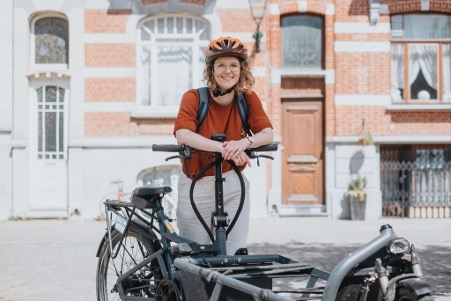
The shared cargo-bike offer was chosen because Cambio (a carsharing operator) was already developing a shared cargo-bike offer in Brussels through its Cargo Bike program, making a local extension straightforward to set up; success here would have meant sustained bike usage beyond the pilot period.
The social taxi service “Mobitwin by Cambio” intervention was chosen because it addressed a concrete operational problem raised by Mobitwin itself, a shrinking volunteer pool tied to declining private car ownership. Success here meant financial viability, since a sustainable model would let the service keep improving access to essential services for people with reduced mobility rather than depend on one-off funding, without generating a structural loss for Mpact.
- Cargo bike sharing, phase 1 (April-May 2025): Two free cargo bikes via the ShareABike platform: one at GC Nohva, one at Ferme Nos Pilifs.
Partners: ShareABike, Cambio, MonkeyDonkey, GC Nohva, Ferme Nos Pilifs - Cargo bike sharing, phase 2 (September-October 2025): Two MonkeyDonkey cargo bikes (front-loader and back-loader), both relocated to GC Nohva, using MonkeyDonkey's own app and locks.
Partners: MonkeyDonkey, GC Nohva - Social taxi (Mobitwin by Cambio): Volunteer drivers use Cambio carsharing vehicles free of charge to transport persons with limited mobility.
Partners: Cambio, Mobitwin (Mpact) - Peer-to-peer car-sharing service (Cozywheels) - Aborted: Peer-to-peer vehicle sharing between businesses and local residents outside business hours. Aborted after market consultation: no interest due to fiscal treatment, key-exchange logistics and reputation concerns.
Partners: Cozywheels (Mpact)
The cargo-bike pilot ran in two phases. The first, launched in April to May 2025 through the ShareABike platform (platform to unlock the bikes), placed two free bikes at different locations: one at GC Nohva, supplied by Cambio, and one at Ferme Nos Pilifs, supplied by MonkeyDonkey. Both saw very low usage. At GC Nohva, the bike stood behind a gate, was not visible from the street, and lacked communication material. At Ferme Nos Pilifs, the bike was parked at the back of a lot, exposed to rain, and located at a shop the user first had to visit before taking the bike home, which added friction to the process. The ShareABike app itself was only available in French, required the project manager to manually add each user, and had a complex unlocking process with locks that did not always work. The result was 5 registered users at GC Nohva and none at Ferme Nos Pilifs.
The pilot was relaunched in September to October 2025 with two MonkeyDonkey bikes, a front-loader and a back-loader, both relocated to GC Nohva. This phase dropped ShareABike entirely in favour of MonkeyDonkey's own app, which came with automated registration, multi-language support, better visibility, and easier access. Communication was reinforced with 500 flyers distributed in the village centre. Usage picked up immediately, with 8 additional participants signing up the day after flyering, and usage remained higher than in the first attempt throughout the pilot. MonkeyDonkey subsequently decided to continue operating in the area after the pilot ended, the clearest sign of viability across the three Brussels interventions.
Mobitwin by Cambio intervention followed a slower path. Volunteer recruitment opened in November 2025 through a Facebook post on the Mobitwin page, a Cambio newsletter, and dedicated flyers, but uptake stayed low, pushing the timeline from an initial November to December 2025 window to December 2025 to February 2026. Cambio's own operational rules constrained the pilot from the start: drivers had to be existing Cambio clients for more than six months, rides were only allowed on weekdays between 10:00 and 16:00, and no more than 10 volunteer drivers were admitted. Mpact requested that Cambio relax the six-month membership rule to widen the volunteer pool, but this was not possible. A geographic mismatch between where volunteers were registered and where demand was highest, combined with a matching algorithm that prioritised the shortest driver-to-client distance, further reduced the number of possible matches. In practice, only three rides were completed in January 2026 and none in February. Every completed trip was loss-making once matched against the profitability simulation: Cambio's cost structure charges by duration and distance, while Mobitwin's revenue is calculated per kilometre only, so long reservations covering short distances, which volunteers tend to book to guarantee vehicle availability, systematically cost more than they earn. A fixed monthly Cambio subscription fee of ten euros, not included in the original budget, still applied in February despite zero usage, producing a net financial loss each month.
Peer-to-peer car-sharing service (Cozywheels) stayed at the exploration stage. Market consultation confirmed interest in a company neighbour car-sharing model in principle, but potential partners ultimately showed no interest, citing fiscal treatment, the logistics of exchanging keys, and reputation management concerns. No active pilot followed.
Throughout the interventions, the local host site GC Nohva in Neder-over-Heembeek was visited on a bi-weekly basis, and stakeholder communication with Cambio and Mobitwin took place through a mix of digital and in-person meetings, alongside direct email and phone contact with volunteers.
The main lesson from the “Mobitwin by Cambio” pilot is that a duration-based cost structure and a distance-based revenue structure do not combine well at low trip volumes: any partner considering a similar car-sharing-backed social taxi model should first check whether the two pricing logics are compatible, and at what minimum trip volume the model breaks even, before committing to a pilot.
Two further takeaways follow from the data collected:
- First, fixed costs (here, a monthly subscription fee) matter disproportionately when usage is low, so they should be modelled from the start rather than added after the fact.
- Second, the cargo-bike experience shows that visibility, communication and equipment reliability can determine whether a sound concept succeeds or fails. The same intervention, run twice with the same partners, produced a discontinued pilot and then a service the operator chose to keep it. With hindsight, running a small-scale financial stress test against realistic (low) volume scenarios before launch, as was eventually done for Mobitwin after the fact, would have surfaced the viability risk earlier.


