Living Lab Overview
From Dreams Knowledge Platform
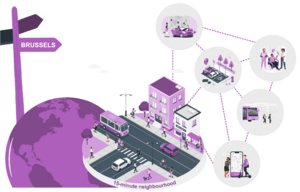
The Brussels Living Lab tested three shared mobility solutions in Neder-Over-Heembeek: a peer-to-peer company car-sharing scheme, shared cargo bikes, and a social taxi service using volunteer drivers provided with carsharing vehicles. Alongside these pilots, the Living Lab also worked to identify viable business and governance models for this type of service, including the potential of flexible mobility-activity hubs at existing highly-frequented locations.
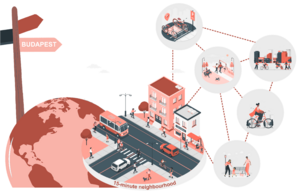
The Budapest Living Lab aims to provide an effective alternative to the reliance on private car usage and low-frequency public transport in the Rákosmente district of Budapest. By encouraging more sustainable transport modes, the living lab seeks to reduce the reliance on single-occupancy vehicles, thereby fostering a greener and more accessible urban environment. A further objective is to test an island-like bike-sharing operation, independent of the large inner-city service area.
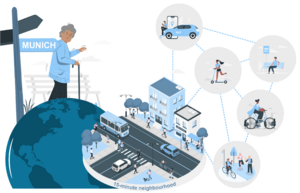
Geretsried, a car-dependent town near Munich with no direct rail link, ran a nearly two-year Living Lab to design a network of mobility points combining car sharing, bike sharing, and better bus connections. A planning process to design a mobility point pilot and scale it up across Geretsried's neighborhoods led to council approval of a pilot at the central B11 bus stop, plus a long-term plan for four more locations.
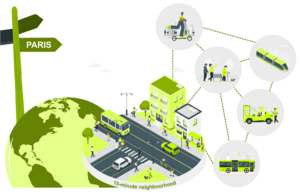
The Paris Living Lab is situated in Évry-Courcouronnes, a suburban new town where peripheral business sectors remain highly car-dependent. To address severe first- and last-mile connectivity gaps to the Tram 12 corridor, the lab tested the deployment of strategic shared mobility stations, discounted shared mobility subscriptions for students, and the creation of a new protected bi-directional bike lane.
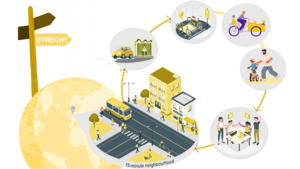
The Utrecht Living Lab explores how shared cargo bikes can become an affordable and accessible alternative to private car use in Overvecht, a spacious and relatively green post-war neighbourhood (Gemeente Utrecht, 2025) where 28% of households live on an income up to 125% of the statutory social minimum, twice the citywide share (Gemeente Utrecht, Onderzoek & Advies, 2026). It examines whether reduced user tariffs lead to greater uptake and develops a cooperative, neighbourhood-based business model as an alternative to purely commercial operation. A further objective is to design a solar-powered charging station that charges cargo bikes where they are parked, reducing operating costs and using renewable energy for shared mobility.
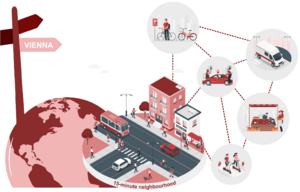
Siebenhirten, in Vienna's 23rd district of Liesing, is a car-dependent peripheral neighbourhood characterised by large-scale social housing, limited local amenities, and few opportunities for everyday life within walking distance. The Living Lab set out to explore whether a temporary pop-up hub could improve local accessibility, encourage active travel, and foster social interaction in an area that falls outside the reach of conventional 15-minute city strategies. Over six weeks, the Living Lab tested a mobile community hub — the Raum_Wagen — combining free cultural programming with a temporary bike-sharing station.