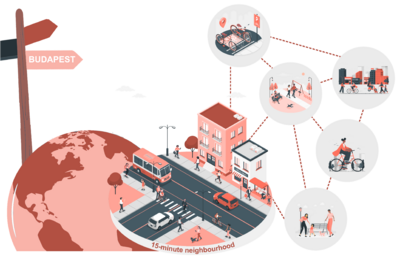
The living lab's core focus is strengthening connections within the Rákosmente district. Enhancing these connections facilitates better movement across neighborhoods and promotes a sense of community among residents. With improved accessibility, residents are more likely to engage with local services, boosting the local economy and encouraging a vibrant neighborhood atmosphere. The primary target group is the local population, but commuters and visitors are also relevant user groups due to the presence of railway stations, educational, healthcare, retail and leisure destinations.
The first isolated operation area of Budapest’s public bike-sharing system is planned to be created in the living lab area. Until recently, the service area has developed organically, but only on densely populated areas around the inner districts of Budapest. In Rákosmente the development focuses primarily on densely populated areas around the district center. This approach not only maximizes the impact of micromobility initiatives but also ensures that they serve the residents who will benefit most.
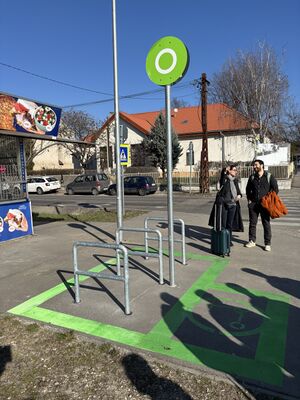
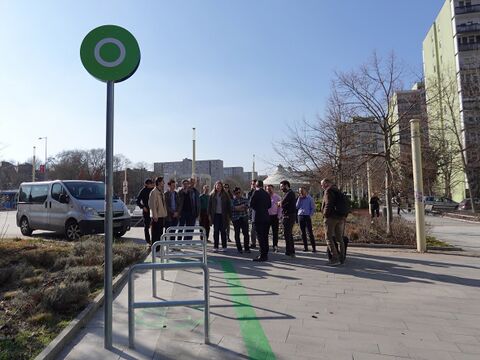
The living lab advocates for new micromobility stations as infrastructure development, enabling residents to efficiently access and utilize shared transport options. At the same time, the standardized stations will serve as convenient pick-up and drop-off points, making it easier for users to integrate micromobility into their everyday routines. This system is expected to complement existing transport solutions, enhancing overall mobility in the city.
- Infrastructure development of micromobility stations. Station location planning, authorisation and implementation.
Partners: RAK, BME, BKK, KTI, Budapest Roads, contractor - Bike-sharing service extension deployment. Service planning, legal requirements and operational framework.
Partners: RAK, BME, BKK, KTI, contractor - Pilot implementation. Pilot design, communication and user-experience evaluation.
Partners: RAK, BME, BKK, KTI
The service focuses on the more densely populated parts of District XVII, which include cultural, institutional, and transport related destinations. The designated stations serve both as pick-up and return locations and as public-space parking areas for other shared micromobility devices. The implementation scope can be divided into three components: the technical development of the site network, the integration into the bike-sharing operational system, and the evaluation of user experience and acceptance.
The exact launch of the pilot depended on the readiness of the central bike-sharing extension implementation that was being realized in the whole city and deployed by an external company. Still, the strategic content of the implementation has not changed. The service integrates 50 bikes and 11 micromobility stations into the bike-sharing application and apply the same terms of use and fare system as in the inner service area. The new stations were developed as integrated mobility points through an investment by the Municipality of Rákosmente.
The most significant operational deviation was the reduction of the planned operating period from six months to three months, caused by the delay in the citywide launch of the extended bike-sharing system. Still, the timing deviation did not affect the content of the testing. The impact of the delay appeared primarily in seasonal comparability, as the summer and early autumn period may provide favourable cycling conditions. However, due to the school holiday, annual leave periods, and temporary changes in commuting patterns, the activity of certain target groups may be lower.
The pilot did not aim to provide continuous coverage of the entire district, but rather to create a network of destinations and transport nodes. The stations are suitable for serving short trips between the district centre, the densest residential areas, two railway stops, and sports, educational, healthcare, and retail destinations. Moreover, the sites were developed not through the application of a uniform template, but with adaptation to the existing public-space cross-section environment.
Compared to the inner-city bike-sharing network, the suburban and polycentric structure may result in longer distances between stations and more concentrated travel destinations. At the railway stations and in the district centre, temporary peak and directional traffic is expected, while at sports, market, healthcare and educational locations, demand may be shaped by institutional opening hours.