Prepare for adoption and financing
Step 9 of 12 Measure Planning
An action programme with owners and dates against it is still something nobody has approved or paid for. This step does two jobs at once. It builds the financial plan, meaning what each measure costs to build and to run, where that money comes from and how the cost is divided between the bodies that agreed to deliver it, and it finalises the plan document, so a political body can adopt it. In the outskirts the money half is the harder one because the services a peripheral package leans on are the ones that do not pay for themselves at local demand levels.
What the Brussels framework actually pays for
Round-trip car-sharing in the Brussels-Capital Region is regulated by the Region and run by private operators, and under the Good Move mobility plan those operators receive no operating subsidy at all. What the Region does instead is change the surrounding conditions. An operator needs regional approval and has to meet conditions on how its stations are spread, so that vehicles reach beyond the densest districts. The regional parking agency sells operators exemption cards for public parking at a nominal annual fee per vehicle. Residents who deregister a number plate can claim an income-scaled bonus that may only be spent on alternatives to the private car, car-sharing among them. The public transport company and the car-sharing operators sell a combined offer, and the service sits inside the regional mobility app next to the other providers. Cambio, the largest round-trip operator, runs profitably in this arrangement and takes no public subsidy.
Nothing in that arrangement is a cheque written to an operator, and that is the part worth carrying home (Deliverable 2.2). The Region finances the service by three indirect routes. It subsidises the demand side by putting money in residents' hands and restricting what it can be spent on. It lowers the operator's cost base using assets the authority already controls, which are parking and street space. And it lifts the operator's revenue by folding the service into the ticketing and the app people already use. Each of those is a governance decision before it is a financial one, which is why the financing plan cannot be drafted by a finance department working alone.
The same deliverable records the other side of that integration. Building a service into a regional mobility platform costs an operator real money, and operators are reluctant to spend it without some assurance of the journeys it will return, so an authority that wants the integration usually has to fund part of it. Treat platform integration as a line in your budget rather than as a favour you can ask for.
Why a peripheral service does not pay for itself
Compared with a dense district, a shared service in the outskirts carries lower vehicle occupancy and higher overheads, since the same fleet is spread across more ground, and its one structural advantage is that parking costs less (Deliverable 2.2). Free-floating operators have little commercial reason to be there and concentrate where density carries them, so a plan that assumes they will arrive unaided is planning on nothing. Station-based round-trip car-sharing travels furthest into low density, particularly for households weighing up whether a second car is still worth keeping, and it is the model most likely to reach a balance with modest support.
Mobility hubs need a different frame again. The review found no business case for a hub network and no business model that can be applied to one because a hub is not a business. It is infrastructure a public authority provides, maintains and brands, and the business models sit with the operators using it, with subsidy where local density will not carry them. A hub therefore belongs in the plan as a capital line with a maintenance line attached, not as a service expected to recover its costs. That distinction matters when a package mixes hubs with the other intervention families because each family reaches financial viability by a different route and a single funding assumption across all of them will be wrong somewhere.
Routes to a funded service
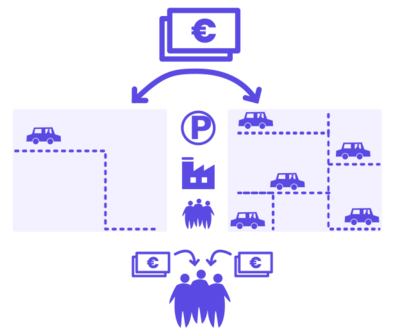
The DREAMS comparison of governance and business models across Belgium and France turns up a small set of arrangements that have made shared services viable in low density. Most packages need more than one of them, and the useful exercise is to work through the list against each measure rather than to look for a single answer.
A discount is not a business model
The Utrecht lab set out to find a business model that would get shared cargo bikes used in Overvecht, a low-income district where operators were barely present. Its first proposal was a social business model in which authorities would pay operators small incentives to lower prices for specific groups at specific locations. That plan depended on commercial operators staying in the market, and both of the ones the lab was working with left it, TIER withdrew and Cargoroo went bankrupt, which forced a pivot (the Utrecht lab's own account). The lab moved instead towards a resident-run cooperative business model, with local people rather than a commercial operator holding and running the fleet, and used what it learned to inform a municipal subsidy application to help get the cooperative started (Deliverable 6.1).
The most instructive finding from that lab is discouraging. A city travel pass held by tens of thousands of low-income residents already carried a steep discount on shared bikes, and only a few hundred holders were using it. Price was not the barrier it had been assumed to be, and a fare subsidy financed on its own would have bought very little. What makes the discount usable is the work around it, the cycling lessons, the cheap refurbished bikes, the digital help and the trial credits handed out through community centres and food banks. Fund the discount and it's scaffolding as one item, or expect the money to sit unclaimed and the measure to be judged a failure of demand.
A financing plan is only as stable as the operators underneath it. The Utrecht lab had to replan its activities when its cargo-bike operator, Cargoroo, went bankrupt partway through (the Utrecht lab's own account), the kind of event that rarely appears in a mobility plan and routinely decides what is possible. Before adoption, ask how dependent your financing is on any single operators continued existence, not only on the licences and concessions it holds. Two years of funding secured for a service whose only operator can fold meanwhile is not secured funding.
One plan, several votes
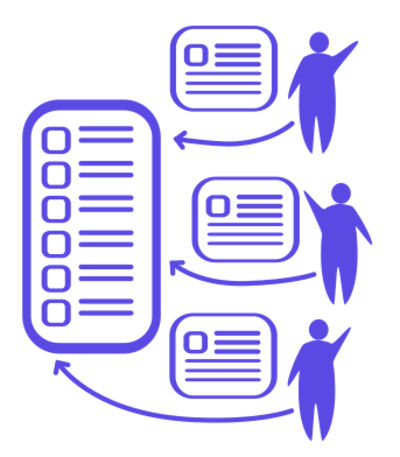
The second half of this step is the document. SUMP asks for the plan to be finalised, and its quality assured before it goes for adoption. Including securing the financing in this step makes a lot of sense. In a periphery, there is usually more than one adoption to secure because the coalition that built the plan reaches across councils that each vote their own budget, and a plan adopted by one of them is not a plan.
Three things follow from that. Write the document, so each body can find its own commitments and its own share of the cost without reading all of it, since a council that cannot locate its obligations will defer the item. Sequence the votes so that an early adoption does not bind a partner who has not yet voted, and be explicit about which commitments are conditional on the later decisions. And put whole-life costs in front of every body, the operating years as well as the build, together with the cost-sharing formula and the fallback you agreed for a share that fails to arrive. Assuring quality means checking the finished plan back against the evidence and the objectives it came from, so that what is adopted is still the plan the analysis supports rather than what survived the drafting.
What goes to the vote is what the next step has to deliver. A measure that reaches adoption with its running costs unnamed will reappear as a problem in its second year, when the launch budget is spent and the service is still needed.