No edit summary |
No edit summary |
||
| (20 intermediate revisions by the same user not shown) | |||
| Line 1: | Line 1: | ||
{{ | {{LivingLab | ||
|name=Vienna | |name=Vienna | ||
|country=Austria | |country=Austria | ||
|city=Vienna | |city=Vienna | ||
|location=48. | |neighbourhood=Wiener Flur, Siebenhirten | ||
|focus= | |begin-date=2025-07-01 | ||
|end-date=2025-08-10 | |||
|participating-organizations=TU Vienna (Move); Raum_Wagen Verein; District of Liesing; Wiener Linien (WienMobilStation); Grätzllabor; imGrätzl; VolxKino; various providers | |||
|location=48.13083, 16.31307 | |||
|description=Siebenhirten, in Vienna's 23rd district of Liesing, is a car-dependent peripheral neighbourhood characterised by large-scale social housing, limited local amenities, and few opportunities for everyday life within walking distance. The Living Lab set out to explore whether a temporary pop-up hub could improve local accessibility, encourage active travel, and foster social interaction in an area that falls outside the reach of conventional 15-minute city strategies. Over six weeks, the Living Lab tested a mobile community hub — the Raum_Wagen — combining free cultural programming with a temporary bike-sharing station. | |||
|focus=Everyday mobility in Siebenhirten relies mostly on the car. Despite being served by the U6 metro terminus, the neighbourhood lacks the walkable, mixed-use environment that makes proximity-based living possible: ground floor spaces are vacant or inactive, public space is sparse, and cultural or community infrastructure is almost absent. Families and older residents are particularly affected, as they depend most on local services and social opportunities within their immediate neighbourhood. | |||
This combination of physical car-orientation and service undersupply made Siebenhirten a fitting and necessary test case on the urban outskirt, where the gap between the 15-minute city ideal and everyday reality is most acute, and where low-threshold interventions have the most to offer. | |||
|approach=The aim of the Vienna Living Lab was to explore in an exploratory way, whether a temporary pop-up hub could catalyse more proximity-oriented and sustainable development at the urban periphery. Success would have looked like residents using the hub for activities they would otherwise have travelled further or longer or would not have been able to attend at all. | |||
The Living Lab chose the Raum_Wagen — a mobile, trailer-based community space operated by the Raum_Wagen Verein — as our core intervention, complemented by a temporary bike-sharing station accessible via the WienMobil App. | |||
The mobile format was a pragmatic response to a structural problem: attempts to activate vacant ground floor commercial spaces in the area failed, as property owners either did not respond or asked for unaffordable rents. Rather than abandoning the idea, the Lab pivoted to public space. The intervention was deliberately kept free of charge, open to all, and programmed with a diverse mix of cultural and community activities to maximise reach across different resident groups. | |||
|interventions=# '''Raum_Wagen pop-up hub''': A mobile, trailer-based community space deployed for six weeks in the Wiener Flur housing complex, offering open seating, coffee, and a weekly programme of free activities<br>''Partners:'' Raum_Wagen, Stadtland, TU Wien, BOKU | |||
# '''Community and cultural programme''': Six weeks of free events including open-air cinema, theatre, circus and graffiti workshops, community dinners, Grätzlcafé, and free bicycle repair<br>''Partners:'' VOLXkino, GrätzLabor, and local workshop providers | |||
# '''Temporary Bike Sharing Station''': A designated pick-up and drop-off zone for shared bikes, accessible via the WienMobil App, located adjacent to the hub<br>''Partners:'' Wiener Linien | |||
# '''Visitor Survey & Observation''': Face-to-face survey with 72 hub visitors on travel behaviour, modal choice, and acceptance of the hub and mobility offers; Observation and count of visitors at the hub (ca. 300)<br>''Partners:'' TU Wien, BOKU, Stadtland | |||
# '''Reflection Workshop''': Online workshop with the project team to consolidate experiential learnings from the intervention<br>''Partners:'' TU Wien, Stadtland | |||
|what-happened=The Raum_Wagen was set up at the corner of the Wiener Flur housing complex in summer 2025 and ran for six weeks. It attracted a mixed resident audience, with families and older adults making up the bulk of visitors. Some programme elements drew more people than expected — the open-air cinema and the graffiti workshop in particular — while others, such as the yoga sessions and the bike-sharing station, saw limited uptake. | |||
Several things made implementation harder than anticipated. The ground floor site the team had originally wanted was not available. Running the intervention in July and August meant a share of residents were away on holiday. There was no weather backup space, which occasionally disrupted outdoor programming. Promotion was mostly limited to the immediate housing complex; reaching residents in the wider neighbourhood was difficult with the resources available. | |||
The survey collected responses from 72 hub visitors. Among residents of Liesing specifically, walking was the dominant mode of getting to the hub — a clear contrast to how they said they would normally travel for similar activities. Public transport use dropped noticeably for this group. Car use did not change much across any group, which is not surprising given the built environment. Removing parking spaces to accommodate the wagon did not generate complaints, which was by no means a given. | |||
The district municipality supported the intervention through the local newspaper and by funding the cinema night. After the project ended, the Local Agenda Liesing started a bicycle-based mobile programme in the district, drawing on the Raum_Wagen experience. That was not something the team planned for, but it is a useful outcome. | |||
|learnings=Start the location search early and treat it as a core planning task, not an administrative step. If you are working in a similar context, look into whether your municipality has any simplified pathways for temporary public space use, and build the lead time in from the start. | |||
Find someone local to be your on-the-ground contact. A resident who knows the space, knows the neighbours, and can open up or check on things when needed would have made a practical difference and probably improved trust with residents too. | |||
Work with what already exists in the city or even neighbourhood. The events that drew the most people were those connected to established formats. Building your programme around existing networks and trusted organisations is more efficient and more effective than starting from scratch. | |||
On timing: summer was convenient for us logistically but not ideal for reach. Autumn or spring would likely give better results in a neighbourhood where a significant share of residents are away in July and August. | |||
Finally, the survey results are indicative rather than conclusive. But even as a first read, the data suggests that when activities are available locally, people walk rather than take transit. That is a useful starting point for a conversation with planners and policymakers about what permanent local infrastructure might achieve. | |||
|headline-image=Raumwagen-c-stadtland-2025.JPG | |||
|headline-image-caption=The Raum_Wagen | |||
|images=Kino-c-stadtland-2025.jpeg/Pop-Up Cinema; | |||
Gitarre-c-stadtland-2025.jpeg/Live-Music; | |||
Spiel-c-stadtland-2025.jpeg/Games for Kids; | |||
Tisch-c-stadtland-2025.JPG/Large table for communal meals; | |||
ViennaLL.png/Cover for the Vienna LL | |||
|image-credits=Stadtland | |||
|accessibility-tool=https://minutemapper-liesing.up.railway.app/ | |||
|survey-results=https://dreams.mobyome.at/index.php?title=Special:Radarchart&file=File:ResimobSurvey-Vienna.csv | |||
}} | }} | ||
Revision as of 08:06, 5 August 2026
Everyday mobility in Siebenhirten relies mostly on the car. Despite being served by the U6 metro terminus, the neighbourhood lacks the walkable, mixed-use environment that makes proximity-based living possible: ground floor spaces are vacant or inactive, public space is sparse, and cultural or community infrastructure is almost absent. Families and older residents are particularly affected, as they depend most on local services and social opportunities within their immediate neighbourhood.
This combination of physical car-orientation and service undersupply made Siebenhirten a fitting and necessary test case on the urban outskirt, where the gap between the 15-minute city ideal and everyday reality is most acute, and where low-threshold interventions have the most to offer.
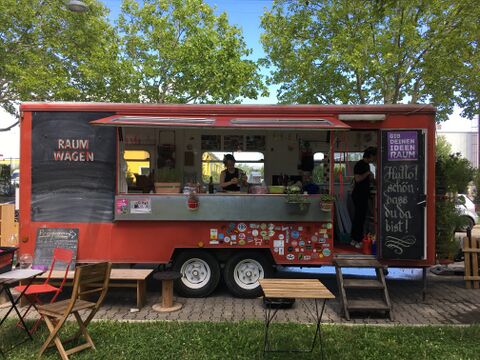
The aim of the Vienna Living Lab was to explore in an exploratory way, whether a temporary pop-up hub could catalyse more proximity-oriented and sustainable development at the urban periphery. Success would have looked like residents using the hub for activities they would otherwise have travelled further or longer or would not have been able to attend at all. The Living Lab chose the Raum_Wagen — a mobile, trailer-based community space operated by the Raum_Wagen Verein — as our core intervention, complemented by a temporary bike-sharing station accessible via the WienMobil App.
The mobile format was a pragmatic response to a structural problem: attempts to activate vacant ground floor commercial spaces in the area failed, as property owners either did not respond or asked for unaffordable rents. Rather than abandoning the idea, the Lab pivoted to public space. The intervention was deliberately kept free of charge, open to all, and programmed with a diverse mix of cultural and community activities to maximise reach across different resident groups.
- Raum_Wagen pop-up hub: A mobile, trailer-based community space deployed for six weeks in the Wiener Flur housing complex, offering open seating, coffee, and a weekly programme of free activities
Partners: Raum_Wagen, Stadtland, TU Wien, BOKU - Community and cultural programme: Six weeks of free events including open-air cinema, theatre, circus and graffiti workshops, community dinners, Grätzlcafé, and free bicycle repair
Partners: VOLXkino, GrätzLabor, and local workshop providers - Temporary Bike Sharing Station: A designated pick-up and drop-off zone for shared bikes, accessible via the WienMobil App, located adjacent to the hub
Partners: Wiener Linien - Visitor Survey & Observation: Face-to-face survey with 72 hub visitors on travel behaviour, modal choice, and acceptance of the hub and mobility offers; Observation and count of visitors at the hub (ca. 300)
Partners: TU Wien, BOKU, Stadtland - Reflection Workshop: Online workshop with the project team to consolidate experiential learnings from the intervention
Partners: TU Wien, Stadtland
The Raum_Wagen was set up at the corner of the Wiener Flur housing complex in summer 2025 and ran for six weeks. It attracted a mixed resident audience, with families and older adults making up the bulk of visitors. Some programme elements drew more people than expected — the open-air cinema and the graffiti workshop in particular — while others, such as the yoga sessions and the bike-sharing station, saw limited uptake.
Several things made implementation harder than anticipated. The ground floor site the team had originally wanted was not available. Running the intervention in July and August meant a share of residents were away on holiday. There was no weather backup space, which occasionally disrupted outdoor programming. Promotion was mostly limited to the immediate housing complex; reaching residents in the wider neighbourhood was difficult with the resources available.
The survey collected responses from 72 hub visitors. Among residents of Liesing specifically, walking was the dominant mode of getting to the hub — a clear contrast to how they said they would normally travel for similar activities. Public transport use dropped noticeably for this group. Car use did not change much across any group, which is not surprising given the built environment. Removing parking spaces to accommodate the wagon did not generate complaints, which was by no means a given.
The district municipality supported the intervention through the local newspaper and by funding the cinema night. After the project ended, the Local Agenda Liesing started a bicycle-based mobile programme in the district, drawing on the Raum_Wagen experience. That was not something the team planned for, but it is a useful outcome.
Start the location search early and treat it as a core planning task, not an administrative step. If you are working in a similar context, look into whether your municipality has any simplified pathways for temporary public space use, and build the lead time in from the start.
Find someone local to be your on-the-ground contact. A resident who knows the space, knows the neighbours, and can open up or check on things when needed would have made a practical difference and probably improved trust with residents too. Work with what already exists in the city or even neighbourhood. The events that drew the most people were those connected to established formats. Building your programme around existing networks and trusted organisations is more efficient and more effective than starting from scratch.
On timing: summer was convenient for us logistically but not ideal for reach. Autumn or spring would likely give better results in a neighbourhood where a significant share of residents are away in July and August. Finally, the survey results are indicative rather than conclusive. But even as a first read, the data suggests that when activities are available locally, people walk rather than take transit. That is a useful starting point for a conversation with planners and policymakers about what permanent local infrastructure might achieve.


